


Schoolchildren from Finestrat perform “Being a person excites” this Friday at the Auditori del Castell
25/05/2026Statement CEIP Balcó de Finestrat and CEIP Puig Campana: CANCELLATION of the “Innovacant” Concert FRIDAY 29
26/05/2026
It represents an investment of €526,000 paid for 100% by the Valencian Generalitat
The reservoir has already begun to receive water and will strengthen the irrigation supply of some 400 hectares of crops
The Regional Secretary of Agriculture, Water, Livestock and Fisheries, Vicente Tejedo, has visited together with the mayor of Finestrat, Nati Algado, and the general director of Water, Lourdes Pérez, the L’Alhambra irrigation pond of the Los Molinos Irrigation Community in Finestrat, after the completion of the works of this hydraulic infrastructure. Also present at the visit were the First Deputy Mayor, Víctor D. Llinares, the Councilor for Works, Guillermo Lloret and the Councilor for the Environment, Estela Álvarez.
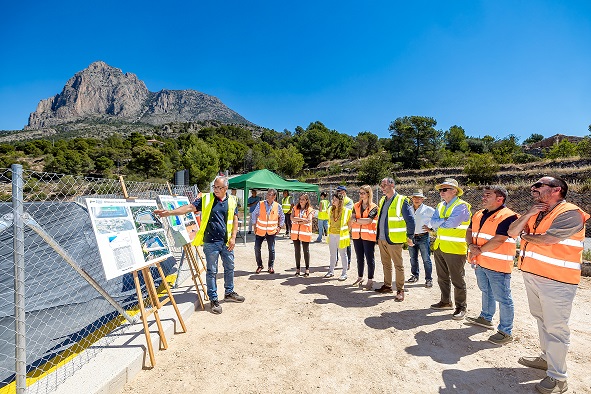
The mayor, Nati Algado, thanked the support of the Generalitat to make this action possible “which was necessary and fundamental to waterproof the sheet of the pond that is already more than 20 years old. With this, we extend the use of this pond over time, guaranteeing its efficiency and functionality for our irrigators. Without this work, it would be practically impossible to continue using the facility. So from the City Council and also from the Community of Irrigators “Los Molinos” that manages this reservoir, express our gratitude to the Generalitat for putting in 1st line of investments this work so important to maintain and preserve the orchard in municipalities like ours “.
This action, promoted and financed entirely by the Ministry of Agriculture, has had a total budget of 526,249.27 euros and has made it possible to completely renew the waterproofing, reinforce safety, regulation capacity and efficiency in the use of water for traditional irrigation in the region.
During the visit, Tejedo stressed that “the Generalitat continues to invest in strategic hydraulic infrastructures that guarantee the future of agriculture and improve the management of a resource as valuable and limited as water”. He also stressed that “this action responds to a historical demand from irrigators and will optimize the storage and distribution of water with greater guarantees of safety and sustainability”.
Technical
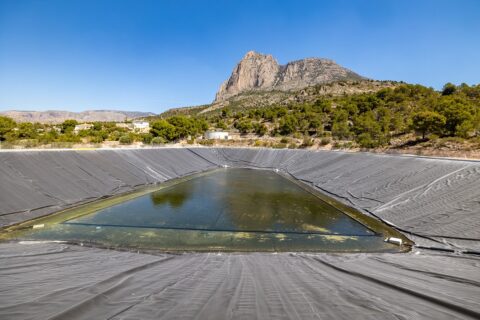
dataThe pond was built in 2000 in the vicinity of the Font del Molí. It is managed by the Los Molinos irrigation community and serves about 400 hectares of orchards. The surface area is 34,110m2 and has a total capacity of close to 51,000 cubic meters, with an approximate useful volume of 42,500 cubic meters.
The works have consisted of the replacement of the old waterproofing sheet, whose useful life had ended, as well as the comprehensive improvement of different hydraulic and safety elements of the installation.
Specifically, a new waterproofing has been executed in addition to a herringbone drainage network, a second emergency drain, new valves, a floating intake and a reinforced concrete lamination manhole.
The intervention has also incorporated new safety measures, to contain the movement of water caused by the wind, HDPE ballasts to reinforce the fixing of the waterproofing sheet and non-slip bands at different points of the reservoir. Likewise, the perimeter enclosure and pedestrian and vehicle accesses have been renewed.
Tejedo remarked that “irrigation communities are an essential ally to move towards more efficient and sustainable water management” and pointed out that “infrastructures like this allow us to reduce losses, improve the use of every drop of water and give stability to the agricultural holdings of the region”.
 The regional secretary has also valued the investment effort being made by the Ministry of Agriculture in the field of irrigation and hydraulic modernization in the province of Alicante and in the Marina Baixa, where new projects aimed at improving the availability and regulation of water resources for the agricultural sector are currently in different stages of processing and development.
For the drafting of this project, the City Council had the support of the Alicante Provincial Council, through Ciclo Hídrico. And the execution of the work is 100% financed by the Generalitat Valenciana, through the Ministry of Agriculture, Livestock and Fisheries.
(PRESS OFFICE (26.5.2026)


